


Here’s the tokenomics read worth your time this week. Venice’s DIEM mechanism lets you lock staked VVV to mint DIEM, and each DIEM pays out $1 a day in API inference credit. The catch is the mint curve: the closer supply sits to its target, the more sVVV you must lock per DIEM. This week two things moved the cost the same direction, and the second one lands on Monday.
What shipped this week
peaq launched Economics 2.0 on 30 July 2026, folding its old six-pool model into four primitives: machine activation, trust validators, a machine pool, and a unified currency flow. Public staking now sits behind trust validators alone, and machine exit permanently destroys half the bonded position. Both systems run in parallel through a transition window. peaq blog, 30 July 2026
NEAR brought Confidential Intents into Meteor Wallet, extending restricted-visibility cross-chain execution from the near.com app to a third-party wallet. The confidentiality rests on TEE hardware, and NEAR exposes a public attestation endpoint so the claim can be checked on-chain by anyone. NEAR Protocol, 28 July 2026
Phala said it brought Kimi K3, Moonshot AI’s 2.8-trillion-parameter frontier model, live for confidential inference inside GPU TEEs. The model runs inside a hardware-attested enclave, so a user can verify the execution environment before trusting it with a prompt. Phala Network, 29 July 2026
Nous Research shipped Hermes Agent support for Buzz, Block’s open-source self-hostable Nostr workspace, with three integration paths spanning a desktop runtime and a relay bridge. The link runs over Nostr, so the agent plugs into a workspace the user can host themselves. MarkTechPost, 31 July 2026
The mechanism: why the DIEM mint eases this week
DIEM is Venice’s staking-into-compute loop. You lock staked VVV in escrow to mint DIEM, stake the DIEM for $1 a day of API credit against any model on Venice, and burn the DIEM to reclaim your sVVV. The mint rate follows an exponential curve, so as supply climbs toward the target, the sVVV you must post per DIEM rises sharply, and the last stretch before the target is where it bites hardest. The full mechanism breakdown has the formula and the maths.
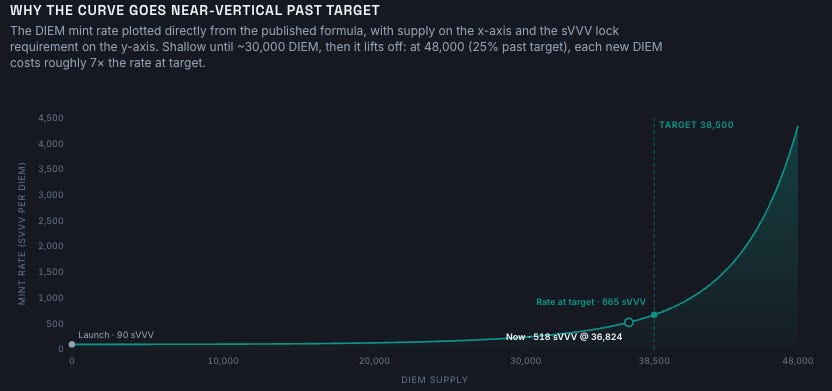
Two things eased that cost this week: supply net-burned further down the curve, and Venice stepped the target up. Supply now sits near 36,800 DIEM, about 96% of the raised 38,500 target, and the lock has fallen to roughly 518 sVVV per DIEM. That is down from about 601 a week ago, and from an April 2026 peak near 685.
The target keeps climbing to 40,000 in four steps of 500, on 3 August, 17 August, 31 August and 14 September 2026. The first landed on Monday, and each further step slides the supply ratio down and eases the lock again.
The DIEM mint-rate curve: sVVV locked per DIEM against DIEM supply, with the current position marked well left of the 38,500 target.
The lock stays shallow until supply nears the target, then goes near-vertical. Today’s supply sits in the flat zone, and stepping the target right keeps it there. Live version: ownyourmind.ai/projects/venice/diem/.
For anyone weighing the mint path, that’s the one actionable read: the sVVV cost of entry has dropped, with three more target steps to come through 14 September. The mechanism is doing what it’s designed to do, correcting the curve when supply and target drift apart.
The structural question sits one layer down. A net burn releases locked VVV back into circulation, which loosens the contractionary pressure the flywheel depends on. Venice’s counterweight went live on 17 July 2026: $5 of every $100 in credit purchases now buys and burns VVV as a separate line item, on top of the monthly buyback. Against emissions cut to 3M VVV a year (from 14M at launch) and roughly 42% of effective supply already sitting at the burn address, the deflationary backdrop holds. Whether the new credit-purchase burn fully offsets the VVV that DIEM burns release is the open question, and it’s the one to watch.
One caveat carries through all of it. Venice sets the target, the pricing and the emission schedule off-chain. None of those parameters sit behind on-chain governance or a timelock, so the self-correcting curve is only as reliable as the company steering it.
Biggest movers this week
7-day change as of 2026-08-01. The tape skewed red: outside NuNet’s thin 20% pop, gains stayed under 8%, while three names shed more than a fifth of their value.
Gainers:
NuNet (NTX) +20.8%
Sentient (SENT) +7.5%
Oasis Network (ROSE) +5.1%
Auki (AUKI) +2.1%
Bittensor (TAO) +1.0%
Fallers:
Giza (GIZA) -43.6%
Heurist (HEU) -37.2%
Vana (VANA) -21.9%
OpenServ (SERV) -21.6%
Allora Network (ALLO) -19.7%
See all movers: ownyourmind.ai/projects/movers/
On the watchlist
Whether anyone mints into the new DIEM headroom. The target step only matters if the supply follows. The rise to 40,000 adds about 2,000 DIEM of headroom, and filling it means locking well over 1M more sVVV, so the headroom is capacity, not a forecast.
The credit-purchase burn offset. The $5-per-$100 stream is the counterweight to sVVV released by DIEM burns. Watching whether it nets deflationary week to week is the real test of Venice’s flywheel.
peaq’s Economics 2.0 transition. Two economic systems are running in parallel while stake migrates to trust validators. The migration holding cleanly, or not, is the thing to check before the old model switches off.
From the site
The DIEM deep-dive carries the full mint-curve mechanism behind this week’s centrepiece, with the live on-chain mint-rate history and a lock calculator: ownyourmind.ai/tokenomics/diem-venice-perpetual-ai-credit/.
The Venice review tracks the three VVV burn streams and the emission-cut schedule on-chain: ownyourmind.ai/projects/venice/.
This week’s essay puts a number on a heavy Claude habit. A month on Claude Max, A$160, bought about 44 times that in tokens at Anthropic’s rates. But the cheap price hides two costs: the data you hand to a closed model, and renting access you could otherwise own. It sets both against Venice, where privacy is checkable and DIEM lets you hold the access: ownyourmind.ai/journal/what-a-heavy-ai-habit-costs/.
The peaq review has a podcast episode this week, useful background before Economics 2.0 settles: ownyourmind.ai/projects/peaq/.
The OYM podcast is on Spotify, Apple Podcasts and the major directories under “Own Your Mind”.
Cheers,
Bobski
Own Your Mind. Independent research on decentralised AI. No sponsors.
ownyourmind.ai · @ownyourmindai · @0xbobski
Disclosure: OYM holds NEAR and VVV.